Soil & Forage Testing
- Soils –
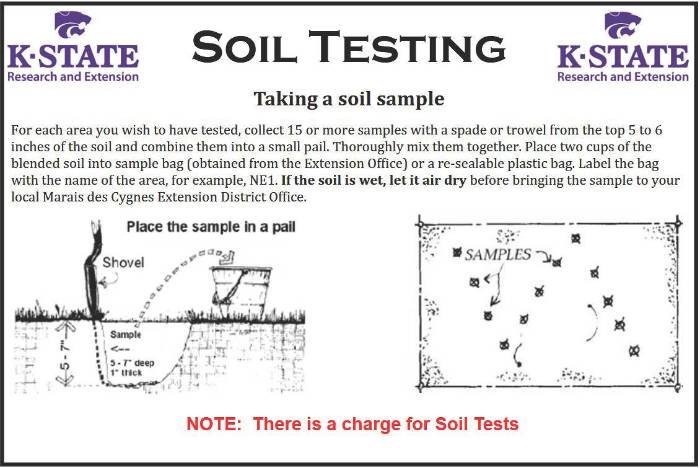
Test results will be as reliable as the sample collected in the field. Proper collection of soil samples is extremely important. Follow these steps to obtain a good soil sample:
-
- Decide if your field can be treated as one sample or needs to be broken down into separate smaller samples. If you believe the soil type, previous crop and fertilizer treatments are consistent across the field, treat it as one sample. If soil type and topography change across the field, different crops have been planted on different parts of the field, or there are problem spots, break the field down into smaller units to sample.
- Using a soil probe (available at the Extension Office) or shovel, dig vertically to a depth of 6 inches for row crop samples and to 4 inches for pasture samples. If the available nitrogen, chloride, or sulphur tests are desired, a subsoil sample to 24 inches is necessary.
- Take at least 10 – 15 samples from the field and mix the samples together in a clean, plastic container to create a representative sample. The more sub samples you take, the more assured you’ll be that soil test results are representative of your field. Put approximately two cups of the mixed soil in a re-sealable, plastic bag. Take the soil sample to your local Extension Office.
- Decide if your field can be treated as one sample or needs to be broken down into separate smaller samples. If you believe the soil type, previous crop and fertilizer treatments are consistent across the field, treat it as one sample. If soil type and topography change across the field, different crops have been planted on different parts of the field, or there are problem spots, break the field down into smaller units to sample.
- Samples should be dry. You can let samples air dry, but do not use heat to dry your samples.
- We will need the following information:
- Name, complete mailing address and phone number
- Location of sample
- Sample depth
- Intended crop and yield goal
- Previous crop
- Lab Results
- The sample will be sent to the Soil Testing Laboratory at Kansas State University for analysis. An Agriculture Agent will make recommendations and the report will be mailed to you. The average time required to complete the analysis is 10 – 14 days.
**************************
- Forage -
Forage testing can be a valuable tool for producers and livestock owners. Whether you have an animal that needs certain dietary components, just want to make sure your herd is consuming the optimal amounts during the winter season, or marketing your hay, testing enables you to take the guesswork out of the nutritional values and know how much protein and energy is in your forage.
You can select a variety of nutrient or nitrate packages or single element tests from the lab. Check out their available tests at the links below. Additional tests can also be custom ordered; contact your local K-State Agriculture Agent for assistance.
Forage Sampling Procedures
Fit a forage probe on the end of a cordless drill to take core samples out of small square or big round bale. After you’ve taken several samples, mix them together in a bucket. From the mixture, pull out enough hay to a quart sized bag, and send it to a testing lab. For more information, check out K-State’s publication on Forage Sampling Procedures and Equipment.
Testing Labs in Kansas
SDK Labs
Follow sampling procedures, fill out sample form from website and mail to lab. SDK Labs requests samples be submitted in plastic bags.
Mail your SDK Labs samples to:
SDK Laboratories, Inc.
1000 Corey Road
Hutchinson, KS 67501
K-State Lab
Follow sampling procedures, fill out sample form from website and mail to lab. K-State Soil Testing Laboratory requests plant samples be submitted in paper bags.
Mail your K-State Lab samples to:
Soil Testing Laboratory
2308 Throckmorton Plant Sciences Center
1712 Claflin Rd
Manhattan, KS 66506
If you need assistance selecting the correct forage analysis or getting your samples mailed, contact our office and we would be happy to assist you. We also have a hay probe available for sampling.
*These resources are listed for informational purposes only. It does not imply endorsement or recommendation of companies or services by either K-State Research and Extension or K-State Research and Extension – Marais des Cygnes District.